Arizona Mobile Home Movers · Statewide Service
Mobile Home Tie Downs & Anchoring in Arizona
Installation, replacement, tensioning and photo-documented inspection of mobile home anchoring systems — built for Arizona monsoon winds and Arizona soil.
Get Your Free Tie Down Quote
Got a deadline from a lender, an insurer or a park? Tell us the date. Call 480-616-0537.
Need a Quote For Mobile Home Transport? Start today…



Why Tie Downs Matter More in Arizona Than Almost Anywhere
Two things make anchoring a bigger deal here than in most states.
Arizona monsoon winds can shift a home when straps are corroded, loose or missing. Arizona soil — from caliche and decomposed granite to sand and expansive clay — also changes which anchor type and depth are appropriate.
Deteriorated or missing tie downs are also a common reason foundation reviews fail during a sale, refinance or insurance renewal.
Why People Call Us About Tie Downs
Deadlines from lenders, insurers, parks, and buyers are common. Tell us the date when you call.
Your Lender Requires It Before Closing
A manufactured home purchase or refinance — especially FHA, VA or USDA — comes with a foundation and anchoring review. If tie downs are missing, corroded or non-compliant, that shows up as a condition and the loan doesn’t fund until it’s corrected. These come with a closing date attached. Tell us the date when you call.
Your Insurance Carrier Is Asking for Documentation
Carriers write and renew manufactured home policies based on how the home is anchored, and after a wind loss they will look at whether the anchoring was adequate. Some ask for photo documentation up front. We inspect, fix what’s wrong, and photograph the finished system.
You’re Selling and the Inspection Flagged It
Buyer’s inspector notes deteriorated or missing tie downs, and now it’s a repair negotiation with a clock on it. We work escrow timelines. Realtors: keep our number.
Monsoon Season Is Coming and You Haven’t Looked
The cheapest version of this job is the one you do in April or May, before the season, when you’re not competing with everyone whose skirting just blew across the park. If your anchoring hasn’t been inspected in five years, it’s worth an hour of somebody’s time.
What We Do
We assess the complete anchoring system, explain the findings, and quote the appropriate scope in writing.
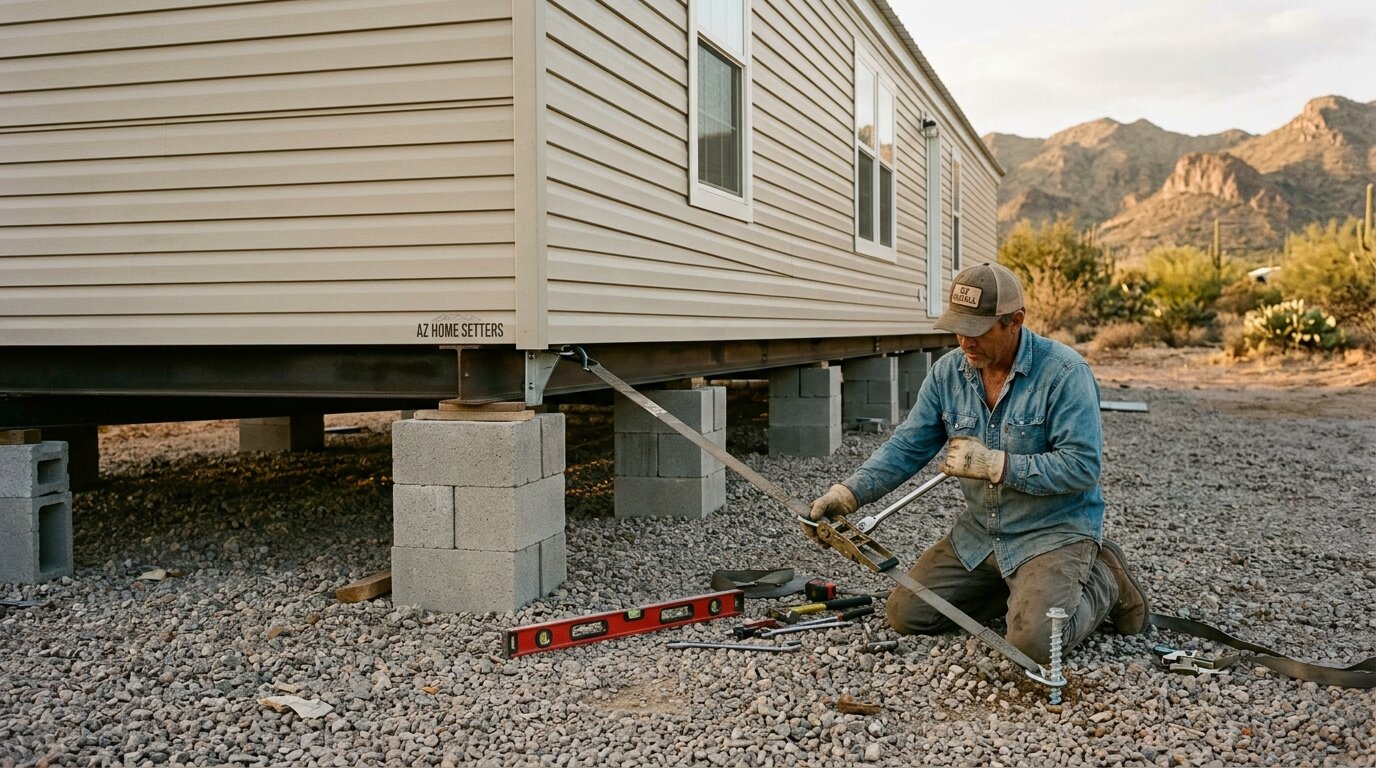
- New ground anchor and strap installation on homes that were never properly anchored
- Replacement of corroded, kinked, frayed, loose or missing straps — the single most common thing we find
- Anchor replacement where anchors have pulled, corroded or were undersized for the soil
- Re-tensioning existing straps that have loosened over time
- Frame ties, over-the-top ties and longitudinal ties as the home requires
- Lateral and longitudinal stabilization review — checking the system as a system, not strap by strap
- Full photo-documented inspection, before and after, for owners, buyers, insurers and lenders
- Anchoring as part of a full setup when we transport and set a home
Arizona’s Department of Housing lists ground-anchor and tie-down installation within the I-10C installer license scope. We confirm the applicable permit and licensing requirements for the specific work before it begins. Review Arizona installer licensing information.
What We Actually Find Out There
After enough of these inspections, the same handful of problems keeps showing up.
The most common findings are rusted straps at the anchor head, anchors that were never driven deep enough, straps with no tension, too few anchors for a double-wide, and anchoring selected for the wrong Arizona soil.
Skirting can hide all of it for years, which is why a photo-documented inspection is worth doing before a lender, insurer or windstorm exposes the problem.
What Tie Down Work Costs in Arizona
Pricing depends on the number of anchors and straps required, soil type and anchor depth, skirting access, clearance beneath the home, and whether re-leveling is also needed.
Inspection, strap replacement, full anchoring-system work, and pre-monsoon reviews are quoted in writing after we understand the home and the requested documentation. Every home is different. Your written quote is the number.
Our Simple Three-Step Process
A clear inspection-to-documentation process, with no mystery scope.
Step 1 — Inspect
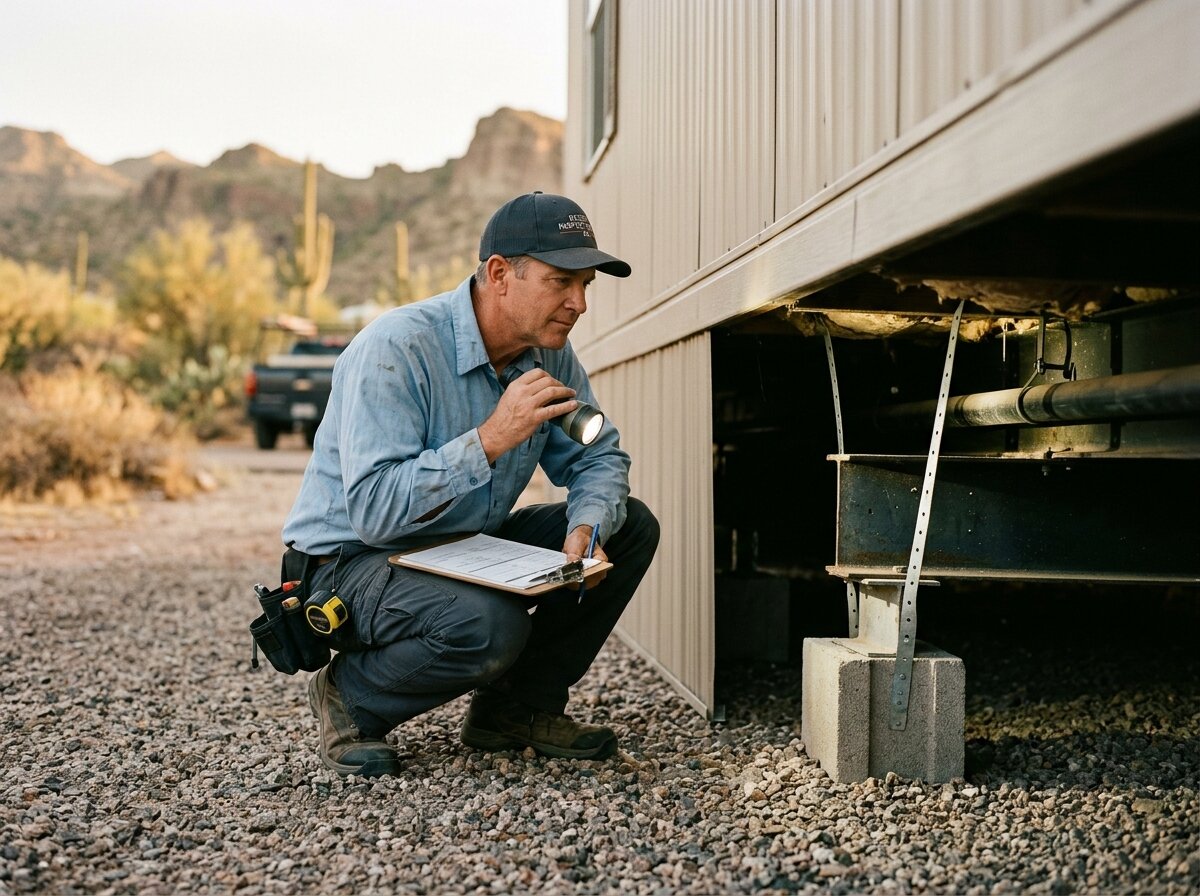
We go under the home and look at every anchor and every strap — corrosion, tension, placement, depth, and whether the system matches what the home actually needs. We photograph what we find.
Step 2 — Explain
You get a plain-English rundown of what’s wrong and what it costs, with photos. Not a mystery invoice. If your lender or insurer sent you a specific list, we work off that list.
Step 3 — Complete and Document
We do the approved work and photograph the finished system. You get before-and-after documentation you can hand to whoever asked for it.
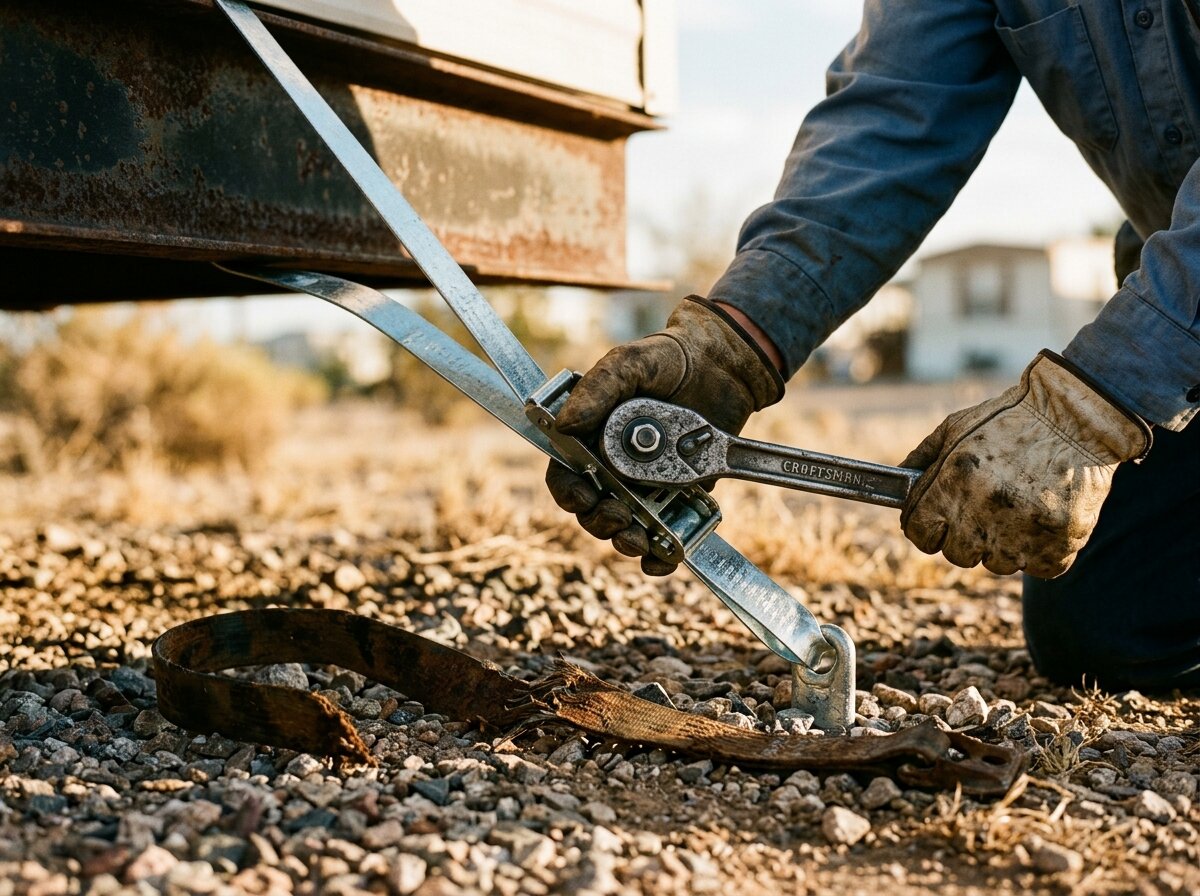
Mobile Home Tie Down Project Photos
Real Arizona project conditions—from exposed anchoring systems to completed setup work.
What Our Customers Say
David Schrock
★★★★★
Dan was great to work with and very reasonable with price of the mobile home I bought from him.
Michael Edwards
★★★★★
Dan is a stand up guy, he is timely, and we are proud to know him.
Marybeth Andree
★★★★★
Arizona Mobile Home Movers were excellent to deal with—fast, friendly, courteous, and efficient.
Tie Down Service Across Arizona
We install and inspect mobile home tie downs statewide — Phoenix, Mesa, Chandler, Gilbert, Glendale, Apache Junction, Sun City, Casa Grande, Maricopa, Coolidge, Florence, San Tan Valley, Tucson, Green Valley, Prescott, Prescott Valley, Cottonwood, Camp Verde, Payson and beyond.
Mobile Home Tie Down FAQs
Straight answers about inspections, documentation, timing, soil, and closing deadlines.
Are tie downs required on mobile homes in Arizona?
Manufactured homes in Arizona are required to be anchored as part of a proper installation, and installation work is regulated by the Arizona Department of Housing. Beyond the code question, parks, lenders and insurance carriers commonly have their own anchoring requirements — and those are usually what prompt the call. If someone has told you your anchoring isn’t adequate, call us and we’ll look at it.
How often should mobile home tie downs be inspected?
There’s no universal schedule, but a practical rule for Arizona: look at them every few years, and always after a major wind event. Straps corrode, ground shifts and tension is lost gradually. If yours haven’t been inspected in five years or more, they’re worth a look before monsoon season.
How do I know if my tie downs are bad?
Signs you can check yourself: visible rust or fraying where the strap meets the ground, straps you can move by hand, anchor heads that have pulled up out of the soil, straps that are obviously slack, and doors or windows that have started sticking (which can indicate the home has shifted). If you see any of that, don’t wait for monsoon season.
Will my insurance company require tie down documentation?
Some do, particularly on older manufactured homes and at renewal. And after a wind loss, anchoring condition is something carriers look at. Photo documentation of a properly anchored home is worth having on file regardless of whether anyone’s asked for it yet.
My lender says my home needs tie downs before closing. Can you help?
Yes — and tell us your closing date when you call. Lender conditions on manufactured homes frequently involve anchoring, and these jobs run on someone else’s clock. We inspect, correct what’s flagged, and give you photo documentation of the completed work.
Note: some lenders additionally require a foundation certification signed by a licensed professional engineer. That’s a separate document from our inspection and repair work — see our HUD foundation inspection page for how that fits together.
Do you have to remove the skirting to work on tie downs?
Usually at least partially, in order to reach the system. We put it back — and if panels are already damaged or brittle, we can handle skirting repair at the same time, which saves you a second mobilization.
How long does a tie down job take?
An inspection is typically an hour or two. Strap replacement on a single wide is often a same-day job. A full anchoring system on a double wide can run a day or more depending on soil, access and how many anchors are required.
Does soil type matter for anchoring?
Considerably. Arizona has caliche, decomposed granite, sand and expansive clay, and each one holds an anchor differently. Anchor type and depth should reflect the soil the home actually sits on — which is part of why an anchoring job done correctly in Chandler isn’t automatically correct in Prescott.
My home shifted in a windstorm. What now?
Call us and don’t wait. We’ll inspect the anchoring, document the condition with photos — useful if you’re filing an insurance claim — and tell you what it takes to get the home properly re-leveled and re-anchored.
Do you install tie downs on homes you didn’t move?
Yes. Most of our tie-down work is on homes that aren’t going anywhere — homes being sold, refinanced, insured, or just prepared for monsoon season.
Related Mobile Home Services
Arizona Mobile Home Movers
Ready to Get Your Tie Downs Handled?
Inspection, repair, replacement and documentation — statewide. Call 480-616-0537 or Get My Free Quote